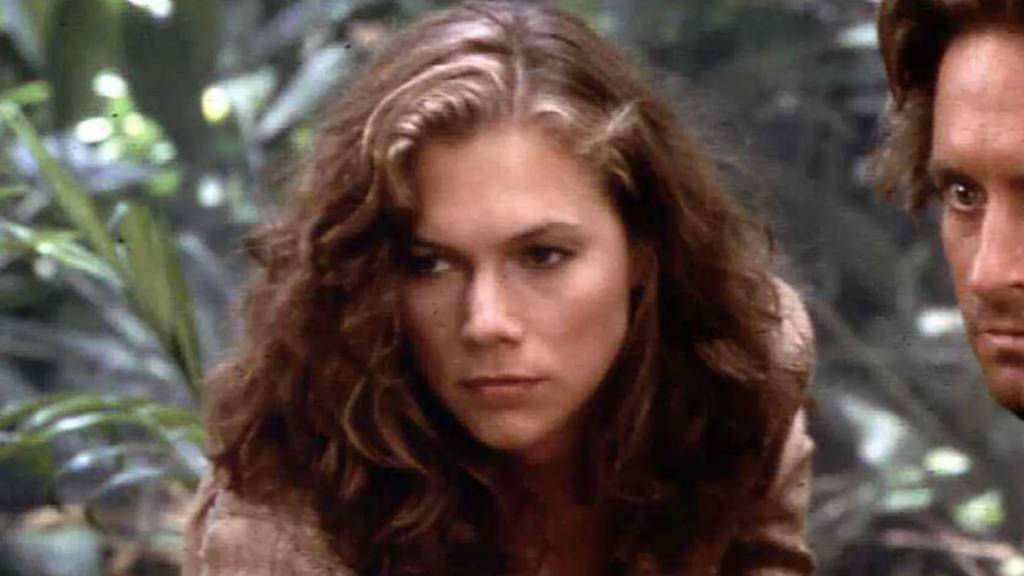
One of my favorite eye opening moments in all of cinema is watching Joan Wilder’s whole demeanor shift in Romancing the Stone after she’s recognized by Alfonso Arau (Juan).
“You’re the Joan Wilder the novelist?…. I read your books! I read all your books!”
In mere minutes of screen time, Joan Wilder suddenly realizes her value. Suddenly, she has worth. She finds herself in the fact these men love her spicy romance novels.
Prior to her epiphany, for so much of the film, Joan feels out of place. She’s alone. She’s a woman who lives a solitary existence that revolves completely around her fantasy. She is an author, after all.
In the film’s first half, Joan doesn’t fit in. Whether it’s with her man crazy publisher (Holland Taylor) or her initial struggles with Jack T. Colton (Michael Douglas) in Colombia, she’s an outsider… until she meets Juan that is.
Suddenly, Joan finds herself the center of attention. She isn’t just getting in trouble, or making someone’s life harder. This is when she steps into her clearest, most defined sense of self and it’s a vibrant, gorgeous transition.
At the same time though, it’s one that never quite made sense to me, even after years of watching the now iconic romantic thriller.
Romancing the Stone, for those who may not remember the 1980s and 1990s, follows writer Joan Wilder (Kathleen Turner) who must travel to Colombia in order save her kidnapped sister. The resulting adventure finds the Manhattan based Wilder on a jungle treasure hunt with a strapping adventurer who’s just a little too close to her romance novel heroes. Robert Zemeckis directs the film from a script by Diane Thomas.
Romancing the Stone was one of the movies playing on a loop in the Pierce House in the 1990s. Heck, if I’m being honest, most of Michael Douglas’ filmography played on a loop in the 1990s. I think he filled a 1980s tinged happy place for my Baby Boomer parents.
I’m embarrassed to admit that for a number of years I credited Joan’s striking character development to Jack. What happens shortly after Juan helps them escape in his “Little mule?” That’s right! Jack and Joan dance the night away at a local party before they, you guessed it, make love.
To this frustrated film student, it seemed so simple for so long. It was love. It was sex! Jack T. Colton made a new woman out of her with his sweet, sweet lovemaking.
And no, this reading didn’t thrill me either.
The more I watch this film, and frankly, the older I get, I’ve fallen in love with Joan Wilder’s weirdness, her awkwardness and her realism. She’s a nerdy writer. I probably shouldn’t mention the number of times I’ve stared at my own writing while wanting to cry and say “Damn that’s good!”. Have I celebrated with my dog? That’s for me to know, and you to assume.
Joan’s grown more important to me with each passing viewing, especially as I left my twenties and moved into new phases in life.
Everything came into a stark sense of clarity though when I finally read about Romancing the Stone‘s screenwriter Diane Thomas.
I’ve spent plenty of time talking about the women creators in the entertainment industry who haven’t gotten their due. It’s an arc that remains painfully consistent throughout the middle of the 20th century.
When looking at Romancing the Stone, it hits harder. It cuts deeper. This is a film that was decidedly A-list and is still held up as such more than forty years after its release. The film’s director Robert Zemeckis is now considered a defining voice among contemporary filmmakers. The same is true of Michael Douglas as an actor, especially in the 1980s and 1990s.
Screenwriter Diane Thomas, according to her 1985 LA Times obituary, sold Romancing the Stone for $250,000. She had been working as a waitress when she sold the spec script that she, according to the article spent every spare hour writing for a year.
Before her death in a 1985 car crash at the age of 39, Thomas’ hard work was finally paying off. A marketing major, she’d spent years studying acting while honing her writing.
At the time of her death, the article reports she was under contract to Amblin Entertainment and had (reportedly!) taken a pass at a version of the third Indiana Jones script.
The LA Times quotes Michael Douglas about her Romancing the Stone script. “It just had a spontaneity about the writing… she was not cautious. The script had a wonderful spirit to it… There was a total lack of fear.”
Diane Thomas didn’t have an opportunity to find her career. Romancing the Stone has lived on. This script was her voice. Her idea. It was her vision and she should have had far longer to show us.
Learning about this woman who fought to bring this Romancing the Stone to life as a spec script, Joan Wilder suddenly makes so much more sense to me. She’s real.
As Joan Wilder lets her hair down into the second act of the film, we see Diane Thomas shining through. We see a woman coming into her own not when she falls in love, but when her own talent is recognized and she’s finally seen.

Leave a comment