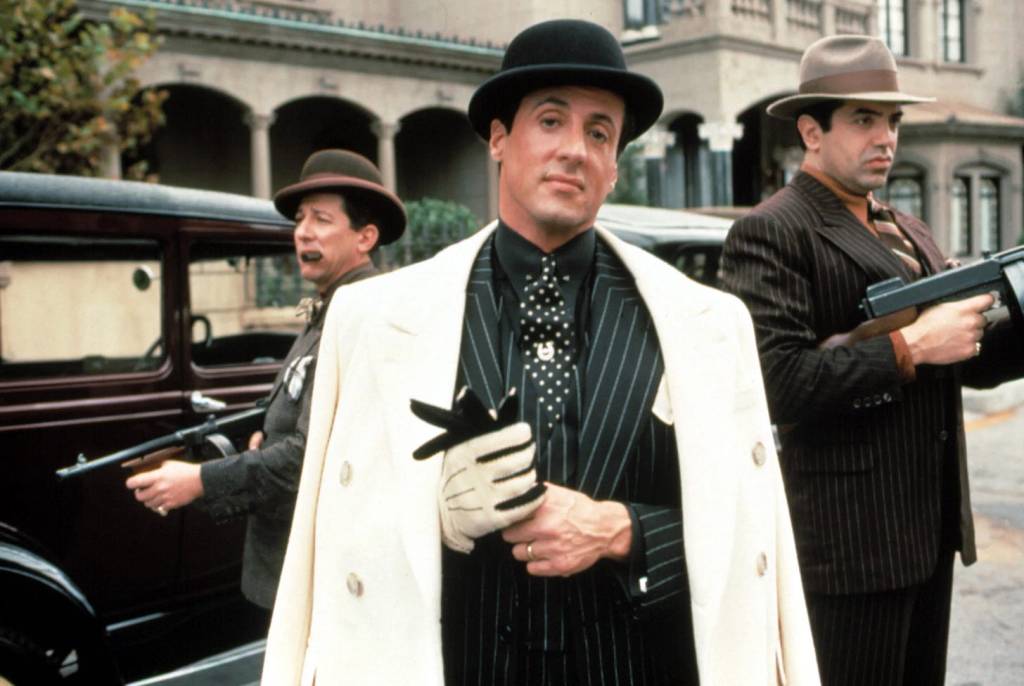
Oscar is a movie that sees a lot of… let’s say, contempt from critics. This Rotten Tomatoes 12 percent is just hostile. I’ve seen some of the movies that are “Guaranteed Fresh.” Frankly, I’ve never particularly understood the hate. Oscar is a gem, and I will not be taking questions at this time.
Oscar holds the distinction of being the movie this critic owned on VHS. I still remember where we bought it… all those far too many years ago.
Cue the nostalgic music, kids.
Right off, there is something that jumps straight out. It’s the Sylvester Stallone of it all.
Sylvester Stallone will always be known — at least at some level– as an action leading man. For those of us who grew up in the 1980s and 1990s, Sylvester Stallone stands alongside Arnold Schwarzenegger and Bruce Willis as superstars who redefined the action genre during the decade.
Oscar, meanwhile, hit theaters in 1991. The 1980s were, of course, an important period for Stallone. Even a quick look at the action mainstay’s IMDB filmography shows Oscar coming smack dab in the middle of a notable stretch. He’d appeared in Tango & Cash in 1989 and Rocky V in 1990 before then top-lining Oscar in 1991. In 1992 he would star in the equally infamous Stop! Or My Mom Will Shoot. Dare we talk about the weirdness of Rhinestone?
I’m going to pose a theory here. Could Oscar’s critical reception result from the fact that Oscar is (to that time at least) Stallone’s biggest “against type” role?
While Sylvester Stallone will always be “Sylvester Stallone,” Oscar does not show the actor in his standard action movie persona. This John Landis-directed film is a comedic love letter to 1930s-era Hollywood slapstick. While his New York gangster character “Snaps” Provolone feels in the “Stallone” wheelhouse, Oscar is far closer to Bringing Up Baby and Trouble in Paradise than Rambo.
Oscar is best called a “drawing room” comedy. The story, which takes place in one New York City town home, follows Provolone as he attempts to fulfill his father’s (Kirk Douglas) deathbed wish for his son to “go straight” and become an “honest man.” It doesn’t take long for the day to go completely out of control.
You couldn’t throw a rock without hitting a work of 1930s and 1940s nostalgia back in the 1990s. Those “of a certain age” can probably remember when (thanks to Brian Setzer!) swing music was everywhere. The 1940s were hip, believe it or not.
In the 1990s, this trend of harkening back to Depression- and Prohibition-era culture reached back fifty years. Oscar itself was a period piece set sixty years in the past. To draw a comparison, when Back to the Future hit theaters in 1985, its 1955-set narrative was only set thirty years in the past. Adults in 1985 didn’t have to be that old to remember the 1950s and early 1960s.
Movies like Oscar harken back to a nostalgia that isn’t as accessible. Even in 1991, this is a world familiar only to those old enough to retire. Could the very act of dropping a contemporary figure like Sylvester Stallone into a film appealing to an older demographic be the reason for the film’s critical struggles?
Audiences looking for Stallone struggle to connect with the nostalgic aesthetic, while those familiar with the world may not connect with Stallone?
Even the film’s casting harkens back specifically to the 1930s, an era when the studio system relied on droves of character actors for every quirky genre part. Oscar’s cast includes not only a host of characters straight from the Golden Age, like Yvonne DeCarlo, Eddie Bracken, Don Ameche, and Kirk Douglas. At the same time, it also brings a host of performers known for their characters. People like the immortal (and perennial Kim favorite) Peter Riegert, Chazz Palminteri, Arleen Sorkin, Art LaFleur, Kurtwood Smith, and “Dickless” himself, William Atherton, to name a few. Kids, this doesn’t even include “Gods Among Men” Tim Curry and Harry Shearer.
None of these actors are figures we can call “movie stars.” While figures like Tim Curry are certainly generational talents and nostalgic favorites, they are character actors. They stand toe to toe with figures like (to name only a few) Nat Pendleton, Porter Hall and S.Z. Sakall, who defined character work in the 1930s and 1940s. Chances are, even if you don’t know their names, you know their faces.
Sylvester Stallone exists as the lone “movie star” in Oscar. Marisa Tomei co-stars here just one year before she would make her Oscar-winning turn in My Cousin Vinny. Stallone is giving a performance that isn’t “against type.” Think of him getting aggravated with the seashells in Demolition Man or his quipping in Tango & Cash. Aside from the lack of bloody action, this is a Stallone-type role in an “against-type” movie. He’s a familiar figure in an unfamiliar world.
All at once, Oscar begins to feel like a cinematic “deep cut.” This is Sylvester Stallone, a “popcorn” actor in a film that’s the furthest thing from it. John Landis is a “popcorn director.” His directorial credit right before Oscar? The legendary Eddie Murphy comedy, Coming to America.
Oscar is a love-letter to nostalgia. This is a movie that’s actively trying to subvert our 1980s and 1990s expectations, and I am very much here for this. It’s just a shame the critics of the time weren’t able to meet this adorable little drawing room comedy on its own terms.

Leave a Reply