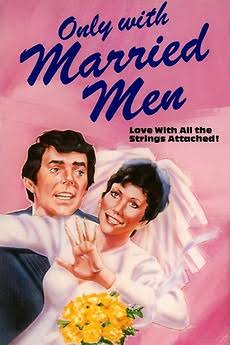
Kids, when a title like Only with Married Men comes along, you’re compelled to click… if you’re me, at least. Then add in a cast including performers like John Astin, Gavin MacLeod, and Judy Carne? Sometimes you have to listen to the 1970s TV movie’s siren call.
Only with Married Men follows a single woman played by Michelle Lee. Think of Doris Day’s character from Pillow Talk in the swingin’ seventies. She’s had her problems with men. Bachelors are terrible. So, she’s made a decision. She’s only going to date married men.
As I said, friends, it’s the seventies.
She’s thrown for a loop, however, when she meets a lawyer (David Birney) who has his own quirky dating life. He pretends to be married to avoid unwanted attachment. Can these two crazy kids make it work? John Astin, Gavin MacLeod, Judy Carne, and Dom DeLuise co-star in the movie. Jerry Paris directs the film from a script by Jerry Davis.
The deeper I got into Only with Married Men, the more I couldn’t shake the feeling that each of the actors was in a slightly different movie. They were all, however, having a blast! That’s important. It’s unfortunate, though, no one quite seemed to be on the same page.
As an example, Gavin MacLeod steals scenes like a bandit wearing a truly terrible toupee and doing his best Charles Nelson Reilly impression. Captain Steubing bends over backwards to play up the camp in a truly memorable way… whether it’s enjoyable or not is up to you.
John Astin, similarly, is having a heck of a lot of fun in his role as a smarmy doctor.
Then again, I have never seen John Astin put a foot wrong. Even at his weirdest and kookiest, he’s always a delight.
John Astin is a National Treasure, and this is not up for debate at this time.
It was frustrating, though, to watch Only With Married Men lose its footing. Honestly, it begins to sag by the second or third commercial break.
Michelle Lee and David Birney struggle under the weight of the narrative, and it quickly becomes a Herculean task to pull this decidedly quirky story through to a network-approved conclusion.
With a plot like this, things could so easily go off the rails, and honestly, I wish it had.
The two leads tried mightily, but when they weren’t surrounded by the colourful cast of supporting characters, this felt like little more than a basic rom-com with a mistaken identity twist. Will these two spunky thirty-somethings find out who the other person really is?
Can Jill (Lee) really continue dating only married men? This is the era of “Second Wave Feminism” and “Women’s Lib” after all.
This is, unfortunately, one of the places where the narrative struggles a bit through a modern lens. There’s a brief acknowledgement of the fact that the other men have wives, namely through Judy Carne’s presence. Ultimately, though, she doesn’t have enough to do to really dive into this. The talented comedian is wasted as a generic “wife” when the “other woman” is clearly the focus.
And ultimately, in casting someone like Michelle Lee as the “other woman”, I wouldn’t say we’re supposed to mistrust or judge her. Her portrayal is clear-eyed and never coded as “evil” or “lecherous”.
Watching the film through, it feels like their goal was to modernise Pillow Talk. Like Doris Day’s Jan, Lee’s Jill has other priorities. She likes her job. She has professional aspirations. This feels like the narrative is trying to explore areas that Pillow Talk couldn’t in the late 1950s.
Doris Day was never the professional virgin her movies wanted her to be. I will die on this hill. She was a professional woman. She had a life, socially, romantically… sexually. She’s just constrained by the late 1950s and early 1960s.
By 1974, we’re fifteen years past Pillow Talk. Standards are changing, and it’s more acceptable to acknowledge that women were in the professional sphere. They were working, and they were even “playing the field”. Heck, this is four years after The Mary Tyler Moore Show premiered, showing yet another woman working, dating, and maybe even (gasp!) having sex.
Thinking of Only With Married Men as a Pillow Talk update gives this ultimately shallow TV movie a fascinating focus. At its heart, this is about a woman moving through the world and the steps she must take to simply exist. Things have changed since 1959. The world was edgier and perhaps a bit more accepting of women in the world.
There are limits, though. This is still network TV.
When all is said and done, Only with Married Men had so much potential. It’s sitting on the cusp of shag-carpeted, 1970s wackiness. Some moments are an absolute hoot. Just as often, though, it’s thoroughly unremarkable. The network has to network, after all, and the result is a TV movie that feels like a slow, uneven time capsule.

Leave a Reply