Over the last few days friends, I’ve been down a deep, dark and honestly, fairly mysterious rabbit hole. I suppose, I should also add, it’s a bit of a depressing one too. You’ve been warned.
The current state of the world leaves plenty of room for this column to take a detour, but fear not, I’m onto my usual wackiness.
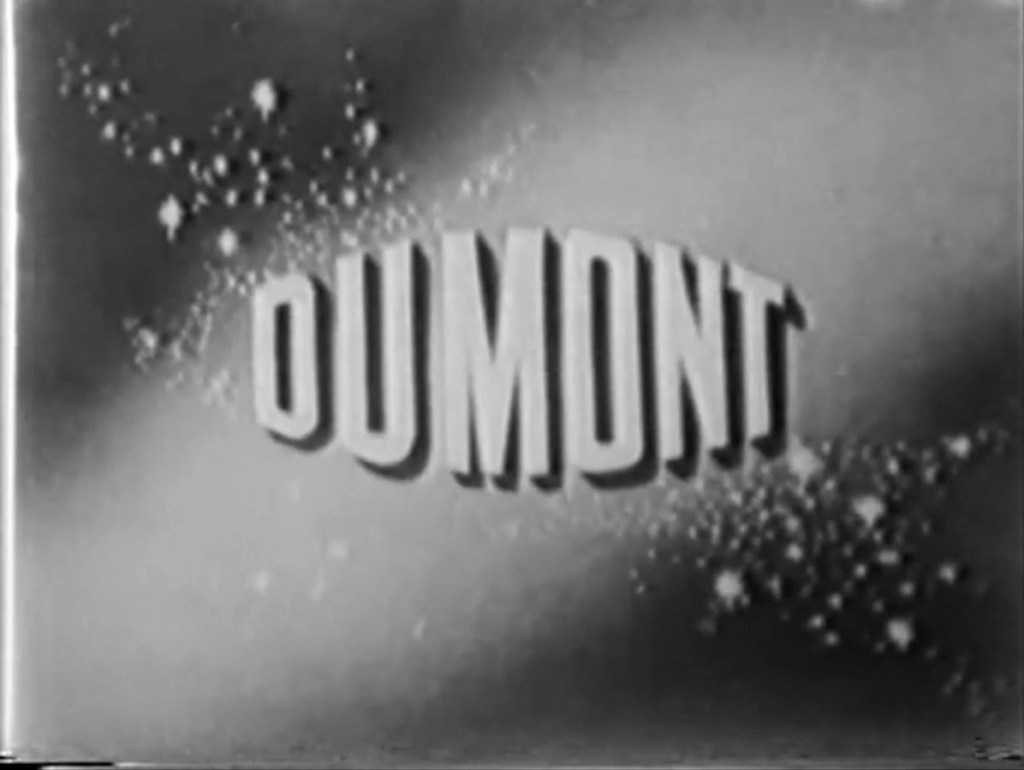
DuMont, my friends. DuMont.
“What?” I hear some of you asking. “The better living through chemistry people?”.
That’s Dupont.
Despite deep diving into all aspects of classic TV for a lot of my nerdy life, I’m still very much a neophyte to the long lost network. I’ve heard the name, but aside from some ventures into Ernie Kovacs’ work, I’ve examined precious little else.
You should all know what’s coming next! A little historical background.
Our story takes us back to almost the earliest days of television history. Most are familiar with the big 3 networks. NBC, ABC and CBS started with a bang and still exist today. However, there was also a fourth. DuMont.
Even in contemporary historical writing, they are still often referred to as “the fourth network”. Kids, this is the case almost 70 years (at the time of posting) since DuMont ceased to exist. They can’t shake it.
When we think on the earliest days of TV, it’s easy to remember back to the early 1950s. Remember, I Love Lucypremiered in 1951. Even in Back to the Future, Loraine gets her first television set in 1955. The technology was growing wildly popular by the middle of the decade.
Considering that, it’s easy to forget that television actually started gaining a foothold in the 1940s. TV schedules exist online as far back as 1946 and DuMont was there right at the beginning. By the middle of the next decade though, they were gone. Most mainstream sources report the network disappeared after 1956.
A look over the DuMont line-up provides a bite-sized look at just how painful it is to be a classic TV fan. Three words. Lack of preservation.
Much has been written in the film community about the preservation struggles in the silent and pre-code era. Television has seen the same issues going back as long as it’s been an existing medium. Outside of some widely loved 1950s sitcoms, many of the shows filling the airwaves in the 1940s and early 1950s have been lost to time.
As I mentioned, DuMont is largely remembered (in comedy and history circles) due to the network airing The Ernie Kovacs Show.
Since his 1962 passing, the innovative Kovacs has grown to hold a sainted position with not only comedy aficionados, but also historians. His wacky and often high-concept work is honestly, unlike much of what was airing on television during this era
At the same time, it’s also been well documented just how much of Kovacs’ work has been lost to time. This is largely due to the tireless work of comedian (and Kovacs’ widow) Edie Adams, who became a tireless advocate for not only her husband’s legacy, but television preservation.
In 1996 Edie Adams gave testimony to a Hearing before the Panel of the Library of Congress. She recounted,
In the earlier 70s, the DuMont network was being bought by another company, and the lawyers were in heavy negotiation as to who would be responsible for the library of the Dumont shows currently being stored at the facility…. One of the lawyers doing the bargaining said he could ‘take care of it’ in a ‘fair manner’ and he did take car of it. At 2 a.m., the next morning he had three huge semis back up to the loading dock at ABC filled them all with stored kinescopes…. took them out on the water…. and dumped them in New York Bay.
Luckily, thanks to the work Adams spearheaded during her life, there are now ongoing preservation efforts to track down and save what Ernie Kovacs footage is still in existence.
Other shows, unfortunately, haven’t been so lucky.
A look over something as simple as the DuMont Wikipedia page is a knife in the heart to classic entertainment fans the world over.
I was “yesterday-years-old” when I stumbled on a Wikipedia entry for The Gallery of Madame Liu-Tsong, a drama that ran for (reportedly!) 10 episodes in 1951.
The series is described as an adventure drama and starred Anna May-Wong as an art gallery owner who’s often pulled into adventure and intrigue. I can not tell you how awesome this sounds! And frankly, how surprised I am a show like this existed in 1951. This would likely still be groundbreaking in 2025. At present, no known copies are known to exist… except the ones that were likely dumped in New York Bay.
Admittedly less groundbreaking, but equally delightful, I present At Home with Billie Burke. I’ve adored Burke since the first time I watched Topper Returns.
Then there’s this little movie of course…
Billie Burke’s timing, her delivery, heck, everything about her persona gives me unbridled joy. So, of course, the thought of her having a talk show makes At Home with Billie Burke a complete tragedy. “Why?” You ask! I can’t watch it! There are episodes featuring Billie Burke answering viewer questions?!? Maybe I should dust off my scuba gear and go grab those kinescopes myself.
Sitting at the bottom of New York Bay. Ridiculous.
These are only two shows in a list of lost media that’s far, far, far too long. So many of these shows belong to DuMont and the fact this history was disposed of so coldly hurts the most. However, DuMont isn’t the only culprit. So much television from the 1940s and 1950s has been lost to time. We’ll never get these performances back. Let’s protect what we still can.

Leave a comment