Ann-Margret is a performer who’s lived in my pop culture consciousness for longer than I care to admit. Over the course of her almost 65-year career, she’s appeared in many of my most formative films. From Bye Bye Birdie to Grumpy Old Men, these are the movies that made me, well… me.
There’s been one film, though, that’s stood the test of time, perhaps more so than any other. Kids, I’ve been watching Viva Las Vegas for as long as I can remember. My family used to watch the bubbly Elvis picture every year before the annual family pilgrimage to Las Vegas.
If I’m speaking honestly, though, the 1964 Elvis Presley feature is my favorite of his lengthy movie career. Nothing else has really come close. Is that a hot take? Luke warm, even?
Viva Las Vegas follows Elvis Presley as Lucky Jackson, an aspiring race car driver doing everything he can to get his car ready for the Las Vegas Grand Prix. Life gets complicated, however, when he finds himself forced to work for his keep.
Ann-Margret co-stars as Rusty Martin, a plucky hotel pool manager who just so happens to have amazing chemistry with Elvis. These two really should have made more movies together. William Demarest, Cesare Danova, and Nicky Blair co-star in the movie.
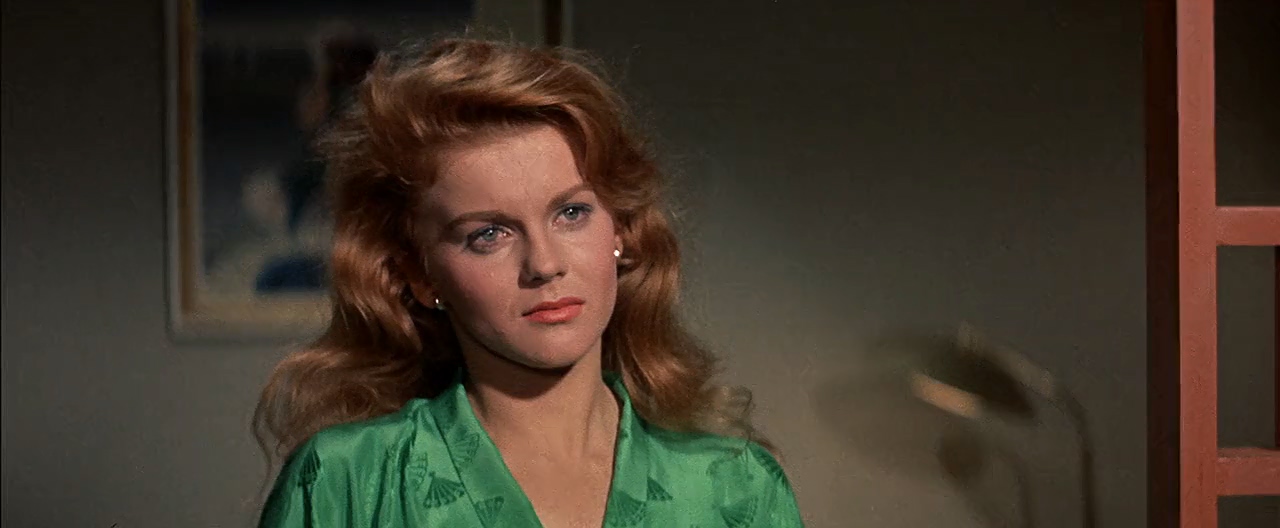
In the early scope of her career, Viva Las Vegas shows Ann-Margret hitting her stride and easily finding her footing. She’s at the top of her game at this point. Her charisma and confidence reverberate off the screen.
Ann-Margret hit the industry fast with four dynamite roles in as many years. Her screen debut came in Pocketful of Miracles in 1961. State Fair followed quickly in 1962. She starred in Bye Bye Birdie in 1963, and Viva Las Vegas came the following year.
To this day, the many who think of Ann-Margret likely do so with the image of her as a swinging mid-sixties ‘Sex Kitten’. Heck, when you run a Google image search, half of her top six images — in my search at least— come from this prominent, middle phase in her career.
In fact, Viva Las Vegas forms a bit of a transitional phase, coming just before she starred in the delightfully titled Kitten with a Whip in 1965.
What has long interested me first and foremost, though, is the earliest years of her career. Those first four films. Friends, I made up my mind long ago that we pigeonhole Ann-Margret. She’s more than simply the sex kitten we’re so anxious to label her as. Frankly, there’s more than I can fit in a write-up of this size.
Before Ann-Margret
When I ask you to think back on the femininity of the 1950s, it’s not hard to come up with an image. Millennials among us likely remember staying home sick from school, and if you were anything like me, you watched the Leave it to Beaver, The Donna Reed Show, and I Love Lucy reruns that played on a loop during the day.
As decades have passed, we’ve actually been guilty of pigeonholing the 1950s into a comfortable, little image of white-picket-fence suburbia. We remember the simplicity. The sitcoms. The consumerism. There’s so much more that can be said.
After World War II, internalized societal expectations held that women, many of whom had taken jobs during the war, return home. Existing as a housewife and raising a family was the goal. It was the aspiration. Even if many might not have been ready.
However, it was also in the 1950s — December 1953 to be exact— that culture started to shift ever so slightly.
Hear me out.
This is when the first issue of Playboy hit newsstands, featuring cover girl, the now iconic actress Marilyn Monroe. And most who haven’t been living under any size of a pop culture rock have likely seen the widely recognized snapshots and know the stories behind them.
In the 1950s culture, we can automatically guess where Playboy would sit with everyone within “proper society”. I’m not prepared to say that the establishment of Playboy ushers in a completely new way of thinking. It didn’t change society. However, the seeds that are planted during this era (which is far more complex) are fascinating.
Sex was gradually becoming more mainstream.
Questions of sex percolated over the decade. Figures like Marilyn Monroe, Brigitte Bardot, and Jayne Mansfield are just a few of the women redefining the idea of the bombshell with each passing film. They transitioned ideas of sexuality from the “good girl” and the “femme fatale” of the noir era to something more acceptable.
Still, however, these women are goddesses. Unobtainable. Otherworldly. You don’t just wander into a grocery store and bump into Marilyn Monroe.
Unless you’re in Hollywood, that is.
Ann-Margret and Internal Agency
Ann-Margret came along a few years later, as I said, in 1961. And by the release of Bye Bye Birdie in 1962, her cultural importance was quickly taking shape.
Ann-Margret, I believe, can be seen as a transitional figure bridging 1950s sexuality and the second-wave feminist movement taking shape in the 1970s.
This exists, even this early in Ann-Margret’s career, in one major shift. She was allowed to be sexual. Even as early as Bye Bye Birdie, when she’s playing 16-year-old Kim McAfee, the camera can’t help emphasizing her appeal. She is filmed with the ability to quite literally transfix the men around her.
I believe, though, that this takes full shape the next year when she’s cast as “Emily” in a remake of the classic 1945 musical State Fair.
State Fair follows the Frake Family as they travel to the Texas State Fair and explore life, love, and pig husbandry. Yes, you heard that right.
Tom Ewell, Alice Faye, Pamela Tiffin, Pat Boone, Ann-Margret, and Bobby Darin co-star in the movie. Jose Ferrer directs the film from a script by Richard L Breen.
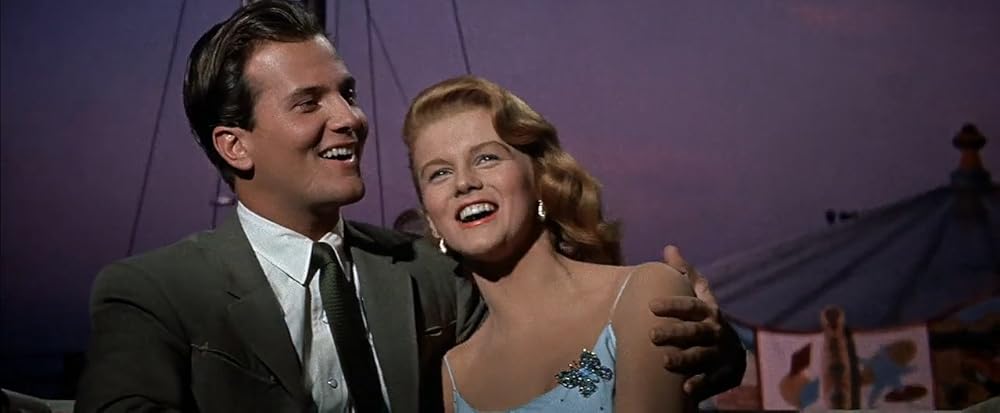
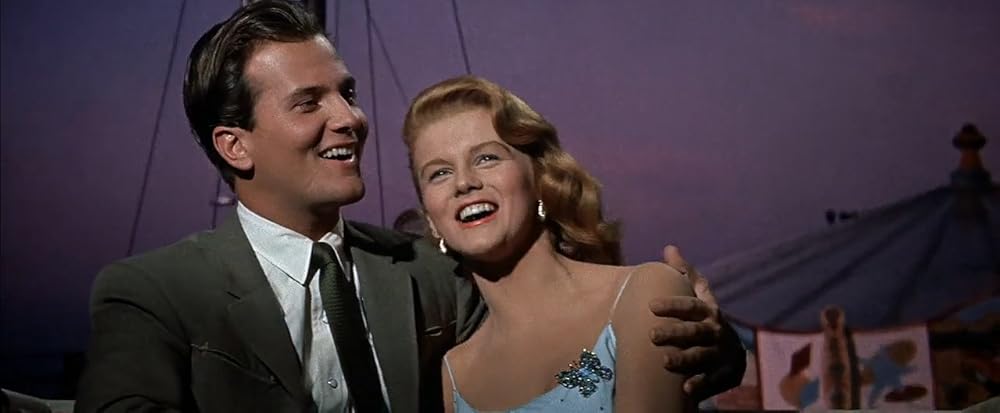
Ann-Margret steps into the role played by Vivian Blaine in the previous film, opposite Pat Boone as Wayne Frake. That’s right, Pat Boone, the ultimate 1950s good boy. This casting says so flipping much.
Back then, Pat Boone was in the late 1950s wave of baby-faced crooners coming up in response to rock and roll. Along with Boone were names like Frankie Avalon, Fabian, and Bobby Rydell.
Pat Boone was — and really still is— the epitome of squeaky clean. He reads scripture on his Facebook page and guest stars in movies like God’s Not Dead 2.
Boone wore white buckskin shoes. Heck, for the longest time, there was an urban legend following him around saying that in his 1957 film April Love, he refused to kiss his co-star Shirley Jones because it would be unfaithful to his wife.
This is the image that followed Pat Boone to State Fair.
Just watch Wayne Frake— played by Boone— have an eye-opening experience at the fair when he meets Ann-Margret’s Emily. He’s transfixed.
Everything becomes strikingly clear in the music number “Willing and Eager”.
Kids, I have been writing about this fascinating music number since my days as a baby film student. It lives in my brain rent-free.
The number shows Wayne and Emily having returned to her hotel room, and they’re feeling— “Willing and Eager”. They’re all over each other. It’s sultry, sweaty, and breathy. He’s shirtless, and while they’re standing on a balcony, there’s something that looks distinctly like a bed in the back of the shot.
That’s right, kids, Ann-Margret’s Emily deflowered the ultimate 1950s good boy. You heard that right.
Throughout State Fair, there’s a fascinating focus on figuring out whether Emily is a “good girl” or a “bad girl”.
And, yes. Good girl and bad girl mean exactly what you think they do. Has she had sex? Is Emily not a (gasp!) virgin?
After a number of times watching State Fair, I can’t necessarily say that the film is sure about Emily. Her dialogue about herself is heavily self-deprecating. She’s written herself off. She’s going through some things. She’s seen things.
At one point, she tells Wayne, “Your friend Emily sure has seen a lot of state fairs.”
… I’m thinking she’s not exactly talking about state fairs in that line.
At the same time, though, I don’t think that film sees her as written off. She’s not unredeemable. She’s not evil.
At this point in time, the United States was coming out of an era that needed to punish a certain type of woman. The bad girl. The woman with a certain amount of, let’s say, experience. All you have to do is look up femme fatale to read about some of these delightfully devious characters.

However, it’s just as often that their crime is… they have a past. They’ve had fun and haven’t saved themselves.
I’m not going to give spoilers for this 63-year-old film, but in a movie that fixates on whether Emily is a “good girl,” and we can easily infer that she does have a past, she’s never explicitly punished. Heck, I think her character judges herself far harder than the film does as a whole.
This likely stems from the fact that we’re watching through Wayne’s eyes. However, shot even a few years earlier, they could have ended this film in a far different way.
It’s fascinating to see in this early stretch of films, particularly State Fair, just how female sexuality was ever-so-slowly shifting. Ann-Margret was a sex kitten. At the same time, though, she could be relatable. She could be the girl next door. And she could live her life. We don’t see her punished for her power. She’s allowed to exist. She’s allowed to be attractive and ultimately, have agency.
In each of her characters, Ann-Margret has power. She exists as certainly a figure of desire, but also of an aspirational femininity. I mean, Elvis pines for her in Viva Las Vegas. Bobby Rydell is in awe of her in Bye Bye Birdie. Pat Boone is transfixed in State Fair. She’s never virginal, and in later films, we see her existing in her own world, traveling, working, and being a gorgeous young woman with means. She shows Hollywood asking questions and ever so gradually realizing that a woman didn’t have to be a good girl or a bad girl. She could be a bit of both. Most of us are.

Leave a comment